What came before the Big Bang? It’s the ultimate cosmic riddle, a question that sends shivers down the spines of physicists and sparks the imaginations of armchair astronomers alike. Forget everything you think you know about time and space – because before the Big Bang, the rules might have been completely different. We’re diving deep into the mind-bending theories, from quantum gravity’s bizarre dance to the mind-blowing possibility of a multiverse, to explore the unimaginable conditions that might have preceded our universe’s explosive birth.
This journey delves into the limitations of our current understanding of time, exploring how concepts like “before” become almost meaningless when applied to a universe without defined spacetime. We’ll unpack the complexities of quantum gravity theories like loop quantum gravity and string theory, examining how they attempt to address the singularity problem at the Big Bang and offer glimpses into a pre-Big Bang era. Then, we’ll venture into the realm of the multiverse hypothesis, considering how multiple universes might explain our own existence and the potential origins of our Big Bang. Finally, we’ll ponder cyclical models, where the universe expands and contracts in an endless cycle of creation and destruction, forever questioning what truly lies beyond the Big Bang.
The Concept of Time Before the Big Bang
The Big Bang theory, while incredibly successful in explaining the universe’s evolution from a fraction of a second after its inception, leaves us grappling with a profound mystery: what, if anything, existed before it? Our current understanding of time, inextricably linked to the fabric of spacetime, breaks down when we attempt to extrapolate it to the pre-Big Bang era. This isn’t simply a matter of lacking data; it’s a fundamental challenge to our very concepts of time and existence.
Applying our current understanding of time to the period before the Big Bang is inherently problematic. Time, as we experience it, is a dimension within the four-dimensional spacetime described by Einstein’s theory of general relativity. This framework beautifully describes gravity and the large-scale structure of the universe, but it breaks down at the singularity – the infinitely dense point at the beginning of the Big Bang. At this point, the equations of general relativity predict infinite density and curvature, rendering them meaningless. Therefore, attempting to define “before” the Big Bang using our current understanding of time is like trying to use a map of Earth to navigate the surface of Mars; the underlying principles simply don’t apply.
Conceptual Challenges in Defining “Before” Without Defined Spacetime
Conceptualizing a “before” in a universe without a defined spacetime presents significant challenges. Our intuitive notion of “before” relies on a linear progression of events within a consistent temporal framework. But if spacetime itself emerged from the Big Bang, then the concept of “before” loses its usual meaning. It’s not merely a lack of information; it’s a question of whether the very framework within which we understand “before” and “after” even existed. Imagine trying to describe the location of a point before a map was created; the concept of location itself is dependent on the existence of the map. Similarly, the concept of “before” might be meaningless without the spacetime framework.
Theoretical Models of a Pre-Big Bang Universe, What came before the big bang
Several theoretical models attempt to address the pre-Big Bang era, each with its own limitations and assumptions. These models often venture into the realm of quantum gravity, attempting to unify general relativity with quantum mechanics – a feat that has eluded physicists for decades. Some propose a cyclical universe, where the Big Bang is merely one iteration in an endless series of expansions and contractions. Others suggest a universe emerging from a quantum fluctuation, a spontaneous burst of energy from a pre-existing “nothingness.” These models are highly speculative, often relying on mathematical frameworks that are difficult to test empirically. The lack of observational evidence makes it impossible to definitively choose between these different models, or even to confirm that any of them accurately reflect reality.
Hypothetical Scenario: The Universe Before the Big Bang
Imagine a state of pure energy, far denser than anything we can comprehend, existing outside the framework of spacetime as we know it. This pre-Big Bang universe might be characterized by intense quantum fluctuations – random bursts of energy and virtual particles constantly appearing and disappearing. These fluctuations, governed by quantum mechanics, might have been the seeds of the Big Bang, creating a highly unstable and chaotic state, with energy density exceeding anything imaginable within our current universe. This is purely speculative, but it illustrates the possibility of a universe vastly different from our own, existing in a realm beyond the reach of our current understanding of physics. This is akin to trying to visualize the internal workings of a black hole, an object whose gravity is so strong that even light cannot escape – it’s a realm beyond our current observational capabilities.
Quantum Gravity and the Pre-Big Bang Era
The Big Bang theory, while incredibly successful in explaining the universe’s evolution from a fraction of a second after its inception, hits a snag at the very beginning: the singularity. This point of infinite density and temperature defies our current understanding of physics, leaving a significant gap in our cosmological knowledge. Quantum gravity theories attempt to bridge this gap by unifying general relativity (which describes gravity on large scales) and quantum mechanics (which governs the behavior of matter at the subatomic level). These theories offer intriguing possibilities for understanding what might have preceded the Big Bang.
The singularity problem arises because general relativity breaks down at the extreme conditions of the Big Bang. Essentially, the equations predict infinite values, which are physically meaningless. Quantum gravity theories propose that at these incredibly small scales, spacetime itself is quantized—meaning it’s made up of discrete units, much like energy in quantum mechanics. This quantization could potentially resolve the singularity, replacing it with a more physically plausible scenario.
Loop Quantum Gravity and its Implications for the Pre-Big Bang Universe
Loop quantum gravity (LQG) is one such theory. It proposes that spacetime is a network of interwoven loops, eliminating the concept of a singular point. Instead of a Big Bang singularity, LQG suggests a “Big Bounce,” where the universe contracts to an extremely dense but finite state before rebounding and expanding. This model avoids the infinite densities predicted by general relativity. Imagine a bouncing ball—it compresses before reversing direction; similarly, LQG envisions the universe undergoing a cyclical process of contraction and expansion. The conditions before the “bounce” are predicted to be incredibly different from our current universe, potentially characterized by radically different physical laws and properties. This provides a potential explanation for the initial conditions of the Big Bang. While still under development, LQG’s predictions are testable, potentially through observations of gravitational waves from the very early universe.
String Theory and its Predictions Regarding Pre-Big Bang Conditions
String theory, another contender in the quantum gravity arena, posits that fundamental particles are not point-like but rather tiny vibrating strings. These strings exist in higher dimensions than the four we experience (three spatial and one time). String theory offers a framework for understanding the universe at its most fundamental level, potentially providing insights into the pre-Big Bang era. Unlike LQG’s Big Bounce, some string theory models suggest a universe that emerged from a pre-existing state or a different type of singularity, though the details are complex and still under investigation. For instance, some versions suggest the possibility of a “pre-Big Bang” universe with different physical constants, possibly even existing in a different number of dimensions. These different conditions could then have given rise to the universe we observe today.
A Simplified Model of Quantum Gravity and Spacetime Near the Big Bang
Imagine spacetime not as a smooth, continuous fabric, but as a granular, pixelated surface. As we approach the Big Bang, these “pixels” become increasingly large and distorted. In classical general relativity, the pixels would shrink to zero size at the singularity, resulting in infinite density. However, in quantum gravity, the pixels might reach a minimum size, preventing the singularity. This minimum size is governed by the quantum nature of gravity. Instead of a singularity, we might have an extremely dense but finite region, representing the pre-Big Bang state. The transition from this pre-Big Bang state to the expanding universe could be visualized as a smoothing out of the pixelated spacetime, where the “pixels” begin to decrease in size, allowing the universe to expand smoothly. This is a simplified representation, but it captures the essence of how quantum gravity modifies our understanding of spacetime near the Big Bang.
The Multiverse Hypothesis and its Relation to the Big Bang
Source: lovinthings.com
The universe’s origins? A mind-bending question, right? Scientists grapple with theories about a pre-Big Bang state, perhaps a quantum fluctuation or something even weirder. Finding refuge from persecution is another kind of universe, one where survival is paramount, as highlighted by the crucial role of Telegram for LGBTQ+ Russians seeking asylum, as seen in this report: telegram lgbtq russia refuge.
Understanding the vastness of cosmic time and the immediate struggles of human existence both demand a similar kind of awe-struck wonder.
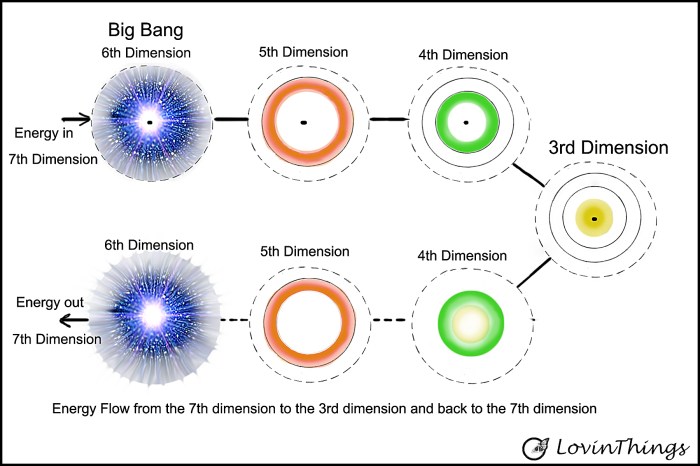
The Big Bang theory, while incredibly successful in explaining the universe’s evolution from a hot, dense state, leaves some fundamental questions unanswered. What, if anything, existed before the Big Bang? Could our universe be just one of many? The multiverse hypothesis attempts to address these profound mysteries by proposing the existence of multiple universes, each with its own physical laws and constants.
The multiverse hypothesis isn’t a single, unified theory but rather a collection of models, each with its own unique mechanisms for generating and relating different universes. These models often emerge from theoretical physics, particularly string theory and quantum mechanics, and attempt to explain observations that standard cosmology struggles to accommodate. The sheer scale and scope of these models often lead to concepts that challenge our intuitive understanding of space, time, and reality itself.
Different Interpretations of the Multiverse
Several distinct multiverse models exist, each proposing a different mechanism for the creation of multiple universes. These models vary significantly in their structure, the nature of the universes within them, and their potential for observational verification. Some prominent examples include the many-worlds interpretation of quantum mechanics, where every quantum measurement causes the universe to split into multiple branches, each representing a different outcome; inflationary multiverse models, which posit that our universe is just one bubble in a much larger, ever-expanding multiverse; and string theory landscapes, where different universes arise from variations in the compactification of extra spatial dimensions. Understanding these models requires grappling with advanced concepts in theoretical physics, but their implications for the origin of our universe are profound.
Multiverse Models and the Origin of Our Universe
Different multiverse models offer varying explanations for the origin of our universe. For instance, in the inflationary multiverse, our universe is a single bubble that emerged from a period of exponential expansion within a larger multiverse. This expansion, driven by a hypothetical field called the inflaton, could have produced countless other universes, each with potentially different physical constants and laws. In the many-worlds interpretation, our universe isn’t “created” in the same way, but rather continuously branches into new universes with every quantum event. These branching universes would be causally disconnected from each other, making them effectively separate universes. String theory landscapes offer a more complex picture, suggesting that the vast number of possible ways to compactify extra dimensions could lead to an enormous number of universes, each with its own unique set of physical laws.
Comparing the Big Bang in a Multiverse Context
The Big Bang, within the context of a multiverse, ceases to be a unique event marking the beginning of everything. Instead, it becomes the origin story of *our* universe, one among many. In a multiverse scenario, the Big Bang might be a recurring event, with universes constantly being created and potentially destroyed. This contrasts sharply with the Big Bang as a unique event, the singular beginning of space, time, and matter. In the latter scenario, the question of “before” the Big Bang becomes nonsensical, as time itself may have originated with the Big Bang. The multiverse hypothesis, however, opens up the possibility of a pre-Big Bang era, where the conditions for our universe’s creation existed within a larger cosmic landscape.
Comparison of Multiverse Theories and Pre-Big Bang Implications
| Theory Name | Description | Pre-Big Bang State | Evidence/Predictions |
|---|---|---|---|
| Many-Worlds Interpretation | Every quantum measurement causes the universe to branch into multiple universes. | No single pre-Big Bang state; universes constantly branch. | Difficult to test; some argue it’s a consequence of quantum mechanics, not a separate theory. |
| Inflationary Multiverse | Eternal inflation produces bubble universes, each with potentially different physical constants. | A pre-Big Bang state of eternal inflation, with quantum fluctuations seeding new universes. | Predictions related to gravitational waves from inflation; some evidence, but still debated. |
| String Theory Landscape | Different universes arise from variations in the compactification of extra spatial dimensions. | A pre-Big Bang state of a higher-dimensional space, where different compactifications lead to different universes. | Indirect evidence through the potential explanation of observed physical constants; highly theoretical. |
| Cyclic Multiverse | Universes are created and destroyed in a cyclical fashion. | The remnants of a previous universe, possibly in a different state. | Highly speculative; requires understanding of quantum gravity and the ultimate fate of the universe. |
Cyclic Models and the Universe’s Evolution
Source: co.uk
The Big Bang theory, while incredibly successful in explaining the universe’s evolution from a hot, dense state, leaves some fundamental questions unanswered, particularly regarding the universe’s origins. Cyclic models offer an intriguing alternative, proposing a universe that repeatedly expands, contracts, and then expands again in an endless cycle, potentially eliminating the need for a singular “beginning.” These models suggest that our current universe is just one iteration in a much larger cosmic timeline.
The cyclical nature of these models offers a fascinating perspective on the pre-Big Bang era. Instead of a single event initiating everything, the pre-Big Bang state is simply the end of a previous cosmic cycle, a period of contraction culminating in a “Big Crunch.” This “crunch” isn’t necessarily the exact opposite of the Big Bang; the physics involved are far more complex, involving concepts from quantum gravity that are still under active research.
Mechanisms for Cosmic Cycle Transitions
Several mechanisms have been proposed to explain the transition between cosmic cycles. One prominent idea involves a “bounce,” where the universe’s contraction doesn’t lead to a singularity (a point of infinite density), but rather to a minimum size before rebounding into expansion. This bounce might be facilitated by exotic forms of matter and energy, whose properties are yet to be fully understood, potentially including effects predicted by string theory or loop quantum gravity. Another approach considers the universe’s expansion and contraction as analogous to a breath, with the Big Bang representing the inhalation and the Big Crunch the exhalation. These transitions aren’t instantaneous events, but rather gradual processes spanning vast cosmological timescales. The precise nature of these transitions remains a major area of ongoing research and debate.
Comparison with the Standard Big Bang Model
The standard Big Bang model predicts a universe that began from a singularity and has been expanding ever since. This model successfully explains many observations, such as the cosmic microwave background radiation and the abundance of light elements in the universe. However, it struggles to explain the universe’s very early moments, particularly the conditions at the singularity. Cyclic models, on the other hand, avoid the singularity problem by proposing a continuous cycle of expansion and contraction. This eliminates the need to explain the universe’s origin from a single point. However, cyclic models also face challenges, primarily in providing observational evidence to support their predictions. Currently, the lack of direct observational support makes the cyclic model a less favored, but still compelling, alternative to the standard Big Bang.
Visual Representation of a Cyclic Universe
Imagine a sine wave, but instead of representing sound, it depicts the universe’s size over time. The trough of the wave represents the Big Crunch, a period of maximum contraction where the universe reaches its smallest size. The peak represents the Big Bang, the moment of maximum expansion. The wave continues endlessly, with each peak representing a new Big Bang and each trough a subsequent Big Crunch. The space between peaks and troughs represents the expansion and contraction phases of the universe. This cyclical pattern repeats infinitely, with each cycle potentially having different characteristics, governed by the specific physical laws operating during each phase. This visual representation illustrates a continuous, self-regenerating universe, devoid of a true beginning or end.
The Nature of Space and Energy Before the Big Bang
Source: co.uk
The period before the Big Bang, often referred to as the pre-Big Bang era, remains shrouded in mystery. Our current understanding of physics, based on Einstein’s theory of general relativity and quantum mechanics, breaks down when applied to the conditions that are theorized to have existed at this time. Exploring the nature of space and energy during this epoch requires venturing into highly speculative territory, relying on theoretical frameworks that push the boundaries of our current knowledge.
The properties of space and energy before the Big Bang are highly debated. Some theories suggest a state of extreme density and temperature, potentially exceeding anything we can currently comprehend. Others propose a different kind of space-time structure, perhaps even one without the familiar dimensions we experience. The concept of “before” the Big Bang itself becomes problematic, as our conventional understanding of time may not apply in such a fundamental state. The very fabric of reality, as we know it, might have been radically different.
Spacetime Singularity and its Properties
The prevailing cosmological model suggests that the universe originated from a singularity—a point of infinite density and temperature. This singularity represents a breakdown of our current physical laws, making it impossible to directly describe the properties of space and energy at this point. While the singularity is a mathematical consequence of general relativity, it is widely believed to be an indication of the limitations of the theory in describing the very early universe. It suggests a need for a more comprehensive theory of quantum gravity, which could potentially provide a more accurate picture of the pre-Big Bang state.
Challenges in Understanding Energy Density and Distribution
Accurately modeling the energy density and its distribution in the pre-Big Bang universe presents a significant challenge. The immense energy densities involved would have led to interactions between different fundamental forces in ways that are currently beyond our capacity to calculate precisely. For example, the unification of gravity with other fundamental forces—a cornerstone of many pre-Big Bang theories—remains a major unsolved problem in physics. Furthermore, the extremely high temperatures and pressures would have resulted in quantum fluctuations that could have played a crucial role in shaping the universe’s initial conditions, but precisely modeling these fluctuations remains a complex task. Consider the uncertainty principle in quantum mechanics: at these scales, the very concepts of precise location and momentum become blurred, adding another layer of complexity.
Key Unknowns Regarding Pre-Big Bang Physical Laws
Many fundamental unknowns plague our understanding of the pre-Big Bang universe. The nature of gravity at extremely high energies, the potential existence of extra spatial dimensions, and the possibility of fundamentally different physical laws are all open questions. Our current understanding of physics is based on observations and experiments conducted under relatively “normal” conditions. Extrapolating these laws to the extreme conditions of the pre-Big Bang era is inherently speculative and fraught with uncertainties. For instance, the very concept of causality—the idea that cause precedes effect—might need re-evaluation in the context of a pre-Big Bang universe.
Theoretical Frameworks and Initial Conditions
Different theoretical frameworks attempt to address the initial conditions of the universe. String theory, loop quantum gravity, and other approaches to quantum gravity offer alternative descriptions of space and time at extremely small scales, potentially providing a pathway to understanding the pre-Big Bang era. These theories often predict different scenarios for the universe’s initial state, some suggesting a universe that emerged from a pre-existing state, others suggesting a cyclical universe where the Big Bang is just one event in an ongoing cycle of expansion and contraction. Each framework makes specific predictions about the universe’s early evolution, offering different explanations for the observed properties of the cosmos. For example, inflation theory, although not strictly a pre-Big Bang theory, offers a mechanism to explain the universe’s homogeneity and flatness, issues that arise from considering the Big Bang alone. However, inflation itself requires very specific initial conditions, which remain a subject of ongoing research.
Final Review: What Came Before The Big Bang
So, what came before the Big Bang? The honest answer is: we don’t know. Yet, the pursuit of this answer pushes the boundaries of human understanding, forcing us to confront the fundamental nature of reality, time, and space. The theories explored – from quantum gravity’s elegant equations to the breathtaking scale of the multiverse – offer tantalizing glimpses into a realm beyond our current comprehension. While definitive answers remain elusive, the journey of exploration itself is a testament to our insatiable curiosity and our relentless quest to unravel the universe’s deepest mysteries. The Big Bang might be the beginning of *our* story, but the story of the universe itself may stretch far, far beyond.