
Resume screening software revolutionizes the recruitment process, streamlining candidate selection and improving efficiency. This technology leverages advanced algorithms and AI to analyze resumes, identifying top candidates based on pre-defined criteria. From small businesses to large corporations, resume screening software offers a range of benefits, including reduced hiring time, improved candidate quality, and minimized bias. This guide explores the functionality, integration, implementation, and future trends of this transformative technology.
We will delve into the specifics of various software solutions, comparing their features, pricing, and integration capabilities. We’ll also examine the ethical considerations surrounding AI-driven screening and discuss strategies for mitigating potential biases. Ultimately, this exploration aims to provide a comprehensive understanding of how resume screening software can optimize the hiring process and contribute to building diverse and high-performing teams.
Resume Screening Software
The market for resume screening software is experiencing significant growth, driven by the increasing volume of applications companies receive and the need for efficient recruitment processes. This software automates the initial stages of candidate selection, saving recruiters time and resources while improving the quality of hires. The market is characterized by a diverse range of solutions, catering to businesses of all sizes and across various industries.
Resume Screening Software Market Landscape
The current market landscape is highly competitive, with a mix of established players and emerging startups. The demand for AI-powered features is driving innovation, with many vendors incorporating machine learning algorithms to improve the accuracy and efficiency of candidate screening. Integration with other HR tools, such as applicant tracking systems (ATS), is also a key trend, creating a more seamless and integrated recruitment workflow. The market is segmented by deployment model (cloud-based vs. on-premise), pricing model (subscription vs. one-time purchase), and functionality (basic matching vs. advanced AI-powered analysis).
Major Players and Feature Comparison
Several major players dominate the resume screening software market, each offering a unique set of features and capabilities. These include solutions like Taleo (Oracle), Greenhouse, Lever, and Workday. Taleo, for instance, is a comprehensive ATS with robust screening capabilities, while Greenhouse focuses on providing a user-friendly platform with strong candidate relationship management (CRM) features. Lever emphasizes collaboration and communication tools, and Workday offers a comprehensive suite of HR solutions including recruitment and screening functionalities. A key differentiator among these platforms is the level of AI integration, with some offering more advanced natural language processing (NLP) and machine learning capabilities than others. The pricing models also vary, with some offering tiered subscriptions based on features and user numbers, while others offer custom enterprise solutions.
Types of Resume Screening Software
Resume screening software comes in various forms. Applicant Tracking Systems (ATS) often incorporate screening functionalities as part of their broader recruitment capabilities. These integrated solutions streamline the entire hiring process, from initial application to offer. Standalone screening tools, on the other hand, focus specifically on the resume screening aspect, often offering advanced AI-powered features for in-depth candidate analysis. Some vendors also provide specialized screening tools tailored to specific industries or roles, allowing for more precise candidate matching.
Comparison of Resume Screening Software Solutions
| Software | Pricing Tiers | Key Features | AI Capabilities |
|---|---|---|---|
| Taleo (Oracle) | Enterprise-level pricing, customized to needs | Applicant tracking, candidate screening, onboarding | Advanced NLP and machine learning for candidate matching and skills assessment |
| Greenhouse | Tiered subscription model based on user numbers and features | Candidate relationship management (CRM), collaborative tools, interview scheduling | AI-powered candidate ranking and screening |
| Lever | Tiered subscription model based on user numbers and features | Focus on candidate experience, communication tools, interview scheduling | AI-powered candidate matching and ranking |
| Workday | Enterprise-level pricing, customized to needs | Comprehensive HR suite including recruitment, screening, and performance management | AI-powered candidate screening and analytics |
Functionality and Features
Resume screening software automates the initial stages of the recruitment process, significantly reducing the time and effort required to sift through numerous applications. This allows recruiters to focus on more strategic tasks, ultimately leading to a more efficient and effective hiring process. The core functionalities and advanced features offered by these tools dramatically improve candidate selection.
Resume screening software offers a range of functionalities designed to streamline the candidate selection process. At its core, this software allows recruiters to upload a job description and then upload a batch of resumes. The software then scans these resumes for s and phrases related to the job requirements, ranking candidates based on their relevance. This automated process significantly reduces the manual effort involved in initial screening. Beyond this basic functionality, many advanced features exist to enhance the efficiency and accuracy of candidate selection.
Core Functionalities of Resume Screening Software
Typical resume screening software offers several key functionalities, including searching, Boolean search capabilities, and basic filtering options based on experience, education, and other relevant criteria. searching allows recruiters to identify candidates possessing specific skills or experience. Boolean search operators (AND, OR, NOT) enable more complex searches, allowing for greater precision in candidate selection. Filtering options further refine the search results, allowing recruiters to focus on candidates meeting specific requirements. For example, a recruiter could search for candidates with “Python” AND “Data Analysis” experience, filtering for candidates with at least 5 years of experience.
Advanced Features of Resume Screening Software
Advanced resume screening software leverages artificial intelligence (AI) and machine learning (ML) to enhance its capabilities significantly. AI-powered candidate matching analyzes resumes in far greater depth than simple matching, identifying candidates who may not have all the explicit s but possess the underlying skills and experience. Skills extraction automatically identifies and categorizes skills mentioned in resumes, providing a clear overview of each candidate’s skillset. This eliminates the need for manual review of each resume to identify relevant skills. Bias detection algorithms help mitigate unconscious biases in the recruitment process, ensuring a fairer and more equitable selection process. For example, the software might flag resumes that lack specific s but show evidence of relevant experience gained through unconventional means, such as personal projects or volunteer work.
Impact of Advanced Features on Recruitment
The implementation of AI-powered candidate matching significantly improves the accuracy and efficiency of the screening process. By going beyond simple matching, the software identifies candidates who may be overlooked by traditional methods, expanding the pool of qualified applicants. Skills extraction allows recruiters to quickly and accurately assess the skillsets of candidates, saving considerable time and effort. This detailed information facilitates better informed decision-making throughout the hiring process. Bias detection minimizes the impact of unconscious biases, promoting fairness and equity in hiring. For example, a company using bias detection software might find that their initial screening process disproportionately favored candidates from specific universities; the software could highlight this bias and suggest adjustments to the screening criteria.
Hypothetical Feature: Predictive Candidate Success
A valuable addition to resume screening software would be a predictive candidate success module. This module would analyze various data points from resumes, such as previous work experience, education, skills, and even personality traits (if ethically sourced and legally compliant), to predict the likelihood of a candidate’s success in a given role. This would involve building a predictive model using historical data on employee performance, and it could incorporate external data sources, such as industry benchmarks or salary data. This feature could significantly improve the quality of hire and reduce employee turnover by identifying candidates most likely to thrive in the company’s culture and the specific role. For example, if the model identifies a pattern linking specific skills and personality traits to high performance in a particular role, it could prioritize candidates exhibiting those traits. This would help recruiters make more informed decisions and reduce the risk of hiring candidates who may not be a good fit.
Integration and Compatibility

Source: hdnux.com
Seamless integration with existing HR and recruitment systems is crucial for the effective deployment of resume screening software. A poorly integrated solution can create more work than it saves, leading to data silos and inefficient workflows. Therefore, careful consideration of integration capabilities is paramount when selecting a resume screening tool.
Effective integration streamlines the recruitment process, minimizing manual data entry and ensuring data consistency across platforms. This reduces the risk of errors and improves overall efficiency. Furthermore, a well-integrated system allows for a more holistic view of candidate information, enabling better decision-making throughout the hiring process.
Common Integration Points
Resume screening software typically integrates with several key HR and recruitment tools. These integration points are designed to automate data flow and enhance the overall functionality of the recruitment process. Common examples include Applicant Tracking Systems (ATS), Human Resource Information Systems (HRIS), and even CRM systems for managing candidate relationships beyond the initial screening phase. The specific integration methods vary depending on the software, but often involve APIs, data imports/exports, or dedicated connectors.
Compatibility with Popular Platforms
The compatibility of different resume screening solutions with popular platforms varies significantly. For example, some solutions may seamlessly integrate with industry-leading ATS platforms like Taleo, Workday, or BambooHR, while others may require custom integrations or lack support for certain systems altogether. Before selecting a solution, it is vital to verify its compatibility with the specific platforms already in use within the organization. A compatibility matrix, often provided by the software vendor, can be a helpful tool for assessing this aspect.
Integration Challenges and Solutions
Several potential challenges can arise during the integration process. Understanding these challenges and their solutions is crucial for a smooth implementation.
- Data Mapping Inconsistencies: Different systems may use different field names or data formats for the same information (e.g., “phone number” vs. “telephone”). Solution: Careful data mapping and transformation during the integration process is necessary to ensure consistent data flow.
- API Limitations: The APIs offered by some resume screening software or integrated platforms might have limitations in terms of functionality or data volume. Solution: Evaluate the API’s capabilities thoroughly before committing to a solution. Consider solutions that offer robust and well-documented APIs.
- Data Security Concerns: Integrating different systems requires careful consideration of data security. Solution: Choose solutions that prioritize data security and comply with relevant regulations (e.g., GDPR, CCPA).
- Technical Expertise Requirements: Complex integrations may require specialized technical expertise. Solution: Engage experienced IT personnel or leverage the vendor’s support services to ensure a successful integration.
Implementation and Use Cases
Implementing resume screening software involves a strategic approach encompassing careful planning, data integration, and user training. Successful implementation hinges on a clear understanding of organizational needs and the software’s capabilities. A phased rollout, starting with a pilot program, often proves beneficial before full-scale deployment.
Successful implementation requires careful consideration of several factors. First, a thorough needs assessment is crucial to determine the specific features and functionalities required. Second, data integration with existing HR systems (Applicant Tracking Systems, HR databases) needs to be planned and executed smoothly. Third, comprehensive training for recruiters and hiring managers is essential to ensure effective utilization of the software’s features. Finally, ongoing monitoring and adjustments are necessary to optimize the software’s performance and address any arising issues.
Implementation Steps
The implementation of resume screening software generally follows a structured process. This ensures a smooth transition and maximizes the software’s impact on recruitment efficiency. The following steps Artikel a typical implementation plan:
- Needs Assessment and Software Selection: Identify specific recruitment challenges, define requirements, and choose software that aligns with organizational needs and budget.
- Data Integration and Setup: Integrate the software with existing HR systems and databases, configure settings according to organizational policies and preferences, and import existing candidate data if applicable.
- Customization and Configuration: Tailor the software to reflect specific job requirements and company preferences, including lists, scoring criteria, and customized reports.
- User Training and Support: Provide comprehensive training to recruiters and hiring managers on how to use the software effectively. Establish ongoing support channels to address user queries and provide assistance.
- Pilot Program and Feedback: Implement a pilot program in a specific department or team to test the software’s functionality and gather user feedback. Use this feedback to refine processes and optimize performance.
- Full-Scale Deployment and Monitoring: Roll out the software across the organization. Continuously monitor its performance, gather data on its effectiveness, and make necessary adjustments.
Industries and Company Sizes Benefiting from Resume Screening Software
Resume screening software benefits organizations of various sizes and across diverse industries. Its efficiency gains are particularly pronounced in high-volume recruitment scenarios.
- Large Enterprises: Large corporations with high recruitment volumes in multiple departments and locations can significantly improve efficiency and reduce time-to-hire using resume screening software. Examples include companies in technology, finance, and healthcare.
- Small and Medium-Sized Enterprises (SMEs): SMEs can leverage the software to streamline their recruitment processes, even with limited HR resources. This is particularly helpful for companies experiencing rapid growth or facing talent shortages.
- Specific Industries: Industries with high applicant volumes, such as retail, hospitality, and customer service, can benefit greatly from automated screening. This allows recruiters to focus on candidate interviews rather than manual screening.
Use Cases and Improved Recruitment Efficiency
Numerous case studies demonstrate the positive impact of resume screening software on recruitment efficiency.
- Faster Time-to-Hire: A large technology company reduced its average time-to-hire by 40% by implementing resume screening software, allowing them to quickly identify and contact qualified candidates.
- Reduced Recruitment Costs: A retail chain reduced its recruitment costs by 25% by automating the initial screening process, freeing up recruiters to focus on higher-value tasks.
- Improved Candidate Quality: A healthcare provider improved the quality of its candidate pool by using resume screening software to identify candidates with specific skills and experience, leading to a higher retention rate among new hires.
Workflow from Setup to Candidate Selection
The workflow typically involves several key stages.
- Initial Setup and Configuration: Defining job requirements, creating lists, and configuring the software’s scoring algorithms.
- Resume Upload and Screening: Uploading resumes (either manually or through integration with job boards) and letting the software automatically screen and rank candidates based on pre-defined criteria.
- Review and Shortlisting: Reviewing the software’s ranked list of candidates, assessing their qualifications, and creating a shortlist of candidates for further consideration.
- Candidate Communication and Interview Scheduling: Contacting shortlisted candidates, scheduling interviews, and managing the interview process.
- Candidate Selection and Offer: Making a final selection, extending job offers, and managing the onboarding process.
Benefits and Drawbacks
Source: cvviz.com
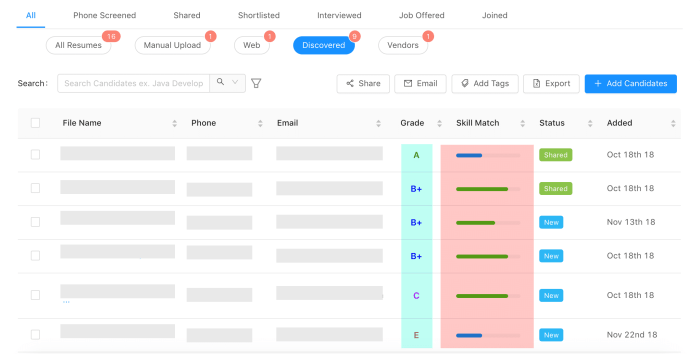
Resume screening software is becoming increasingly sophisticated, helping recruiters efficiently manage large applicant pools. However, just as efficient tools are needed for other content creation tasks, like podcasting, where finding free podcast editing software can significantly improve workflow. Similarly, the right resume screening software can dramatically streamline the hiring process, saving both time and resources.
Resume screening software offers a compelling blend of efficiency and potential pitfalls for recruiters and hiring managers. Understanding both the advantages and limitations is crucial for making an informed decision about its implementation. This section will explore the key benefits, potential drawbacks, and cost-effectiveness of utilizing such software compared to manual screening processes.
Key Benefits of Resume Screening Software
The primary advantage of resume screening software lies in its ability to significantly expedite the candidate selection process. By automating the initial screening stages, recruiters can quickly sift through large volumes of applications, identifying candidates who best match pre-defined criteria. This automation saves considerable time and resources, allowing recruiters to focus on more strategic tasks like candidate interviews and assessments. Furthermore, the software minimizes the risk of human bias in the initial screening, promoting a fairer and more objective evaluation of candidates based solely on their qualifications and experience. Improved efficiency also leads to faster time-to-hire, reducing the overall cost of recruitment.
Potential Drawbacks and Limitations
While offering substantial benefits, resume screening software is not without its limitations. One major concern is the potential for inaccurate or biased results. The software’s effectiveness hinges on the quality and precision of the s and criteria used for screening. Poorly defined criteria can lead to the exclusion of qualified candidates who don’t perfectly match the search terms, while conversely, unqualified candidates might slip through the cracks. Additionally, the software may struggle to interpret nuanced information or evaluate the applicant’s overall suitability for the role beyond the s specified. Over-reliance on software could also lead to a dehumanizing recruitment process, neglecting the importance of human judgment and intuition in candidate evaluation.
Cost-Effectiveness Comparison
Determining the cost-effectiveness of resume screening software requires a careful comparison against manual screening. While the software involves an upfront investment and potentially ongoing subscription fees, the long-term savings can be substantial. Manual screening is extremely time-consuming, especially for high-volume recruitment drives. The cost of employee time spent reviewing resumes, coupled with the potential for errors and missed opportunities, can quickly outweigh the investment in software. For example, a company with 1000 applications for a single role might spend several weeks in manual screening, incurring significant labor costs. Resume screening software could reduce this time to a few days, leading to substantial cost savings in the long run. The return on investment (ROI) depends on factors such as the volume of applications, the complexity of the screening criteria, and the cost of the software itself.
Pros and Cons of Resume Screening Software
| Pros | Cons | Pros | Cons |
|---|---|---|---|
| Increased Efficiency | Potential for Bias | Reduced Time-to-Hire | High Initial Investment (some solutions) |
| Improved Objectivity | Over-reliance on s | Cost Savings in the Long Run | May Miss Qualified Candidates |
| Better Candidate Matching | Lack of Human Judgment | Scalability for High-Volume Recruitment | Technical Expertise Required |
Future Trends and Developments

Source: isu.pub
The landscape of resume screening is rapidly evolving, driven by advancements in artificial intelligence, machine learning, and related technologies. These innovations promise to significantly improve the efficiency, accuracy, and fairness of the recruitment process, while simultaneously presenting new challenges that need careful consideration. The following sections detail some key emerging trends and their potential impact.
AI and Machine Learning’s Expanding Role in Resume Screening
AI and machine learning are transforming resume screening by automating previously manual tasks and improving the accuracy of candidate matching. Algorithms can analyze vast datasets of resumes and job descriptions, identifying patterns and correlations that might be missed by human recruiters. For instance, machine learning models can be trained to identify s and phrases indicative of specific skills or experience levels, allowing for more precise filtering and ranking of candidates. Furthermore, AI can learn to recognize subtle indicators of candidate suitability, such as consistent career progression or participation in relevant professional organizations, leading to a more holistic assessment. This automation reduces recruiter workload, allowing them to focus on more strategic tasks like candidate interviews and relationship building. However, the potential for bias in algorithms must be addressed through careful data selection and ongoing monitoring.
Natural Language Processing for Enhanced Accuracy
Advancements in natural language processing (NLP) are crucial for improving the accuracy of resume screening. NLP allows software to understand the meaning and context of text within resumes, going beyond simple matching. For example, NLP can identify synonyms and related terms, ensuring that candidates with varied wording are not overlooked. It can also understand the context of skills and experience, distinguishing between someone who claims a skill and someone who demonstrably possesses it through quantifiable achievements. Sophisticated NLP algorithms can even analyze the tone and style of a resume, providing insights into a candidate’s personality and communication style. This nuanced understanding reduces false positives and negatives, leading to a more accurate and efficient screening process. For example, an NLP-powered system might identify a candidate with relevant experience even if their resume doesn’t explicitly mention the specific s used in the job description.
Blockchain Technology for Enhanced Security and Transparency
Blockchain technology offers a potential solution to issues of security and transparency in resume screening. By storing resume data on a decentralized, immutable ledger, blockchain can ensure the integrity and authenticity of candidate information. This can help prevent fraud and identity theft, while also increasing transparency in the recruitment process. For example, candidates could have greater control over their data, choosing which information to share and with whom. This enhanced security and transparency could build trust among candidates and recruiters alike. While still in its early stages of adoption in recruitment, blockchain’s potential to revolutionize data management and security in resume screening is significant. Companies are already experimenting with blockchain-based systems to verify credentials and skills, potentially reducing reliance on potentially unreliable self-reported information.
Closing Notes
In conclusion, resume screening software presents a powerful tool for modern recruitment, offering significant advantages in efficiency and candidate selection. While challenges remain regarding bias and ethical considerations, ongoing advancements in AI and machine learning promise to further refine these systems, enhancing their accuracy and fairness. By understanding the capabilities, limitations, and future trajectory of this technology, organizations can leverage its potential to optimize their hiring processes and build stronger teams.
